that time you were young

Remember
that time you were young
and you saw something
you almost forgot
and the faster you ran
the slower you arrived
Van Gogh
was a bit like that


Remember
that time you were young
and you saw something
you almost forgot
and the faster you ran
the slower you arrived
Van Gogh
was a bit like that
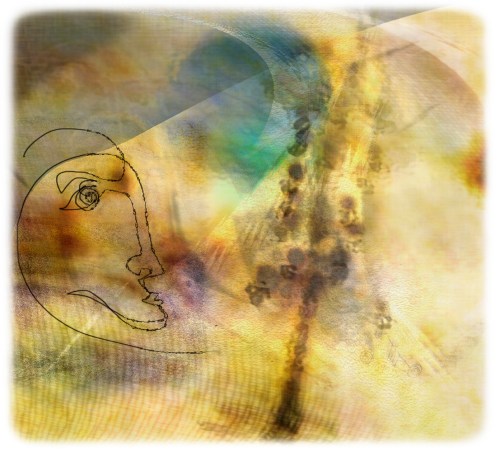
I taste the light
coming through the window.
(from “Odysseus and Circe,” Anne Simpson)


Pouring, like you,
into my heart,
washing over my skin

falling
through glass
lightly

flowing waves and circling particles
currents of surprise, delight.

I am water, and I am a gull, flying …

a gulf wide and deep as Mexico

replenishing after spills and spoils

You fish me, for stars
for pearls
lost boys and missing girls
fallen into the hole of our fears
O is an open mouth,
one closed eye,
and one open
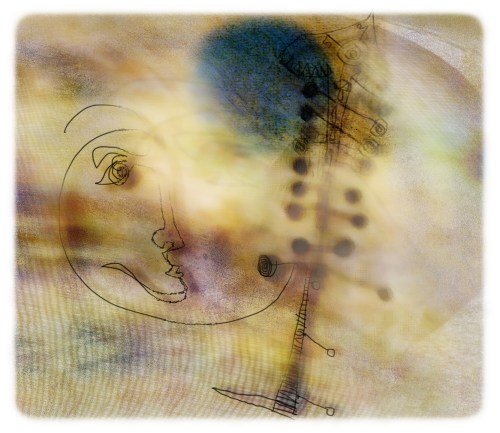

a black hole where light cannot flow
out
now light from the window of opportunity
swallows us whole
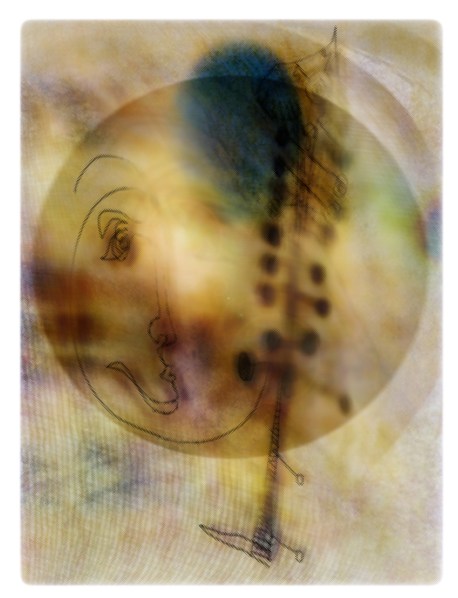
and we shine
we

shine.

Ellen S. Jaffe’s most recent book of poetry, Skinny-Dipping with the Muse (Guernica Editions, 2014) has recently been launched. Tasting the Light is a new poem, not yet published. Ellen lives in Hamilton, writes poetry and prose, and teaches writing in schools and community centres.


Like a certain famous red wheel barrow

so much depends

upon the red

wagon.

My brothers decided to light up a tree. Not sure how much damage the (few) matches did to the knobby crevice where the unfortunate had, seemingly, been struck once upon a time by lightning. Nevertheless, our father, with an abundance of caution ordered buckets of water to make sure the riverbank didn’t burn. Perhaps to teach a lesson, perhaps out of a respect for fire, he kept the buckets coming. Eventually my brothers tired and remembered the wheel had been invented. Wheels and fire. And for whatever reason, like the wheel barrow for William Carlos Williams, much depends upon the red wagon.

Photo of the wagon from the internet, copyright unknown, used non commercially to refashion a new work for purposes of commentary.
Along my flanks edges of me are cool
in the shadows of the trees. The rest of me
is out in the sun, brightly green. I’m green
everywhere, except when I’m not; but even in
the withering of me there’s a memory
of green.

My name is synonymous with green
and like that colour I’m innocence itself.
Everything comes to me for everything comes
to the floor, and I’m the floor of everywhere.

Even beneath the sea you’ll find a version
of me. But most of the time you’ll find me here,
wherever you happen to be. I’ll be waiting. I remain
here for everyone. It is said I cover the dead, and actually
I do. But I much prefer the living.
And the living I live
for most is my darling love. She steps barefoot onto me,
walks my length. I feel myself cooling under each step.
Then she undresses and begins to lie down.
First I feel the shadow of her shape, and then
her shape. I could grow into this. Usually I do.
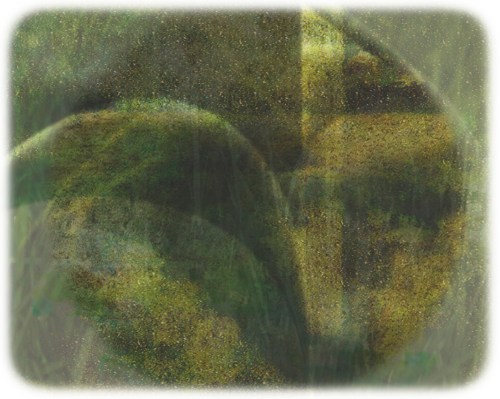
Previously published in Census 2 – From the collection The Offspring of the Moon, Salmon Poetry
John W. Sexton’s mind was poured into his body in 1958; since then his life has been dedicated to poetry.

The photo of the grass I wove into some of my digital compositions is from Wikipedia Commons. Credit Marcus Obal, 2007. I am manipulating this image under the terms of the GNU Free Documentation License, Version 1.2
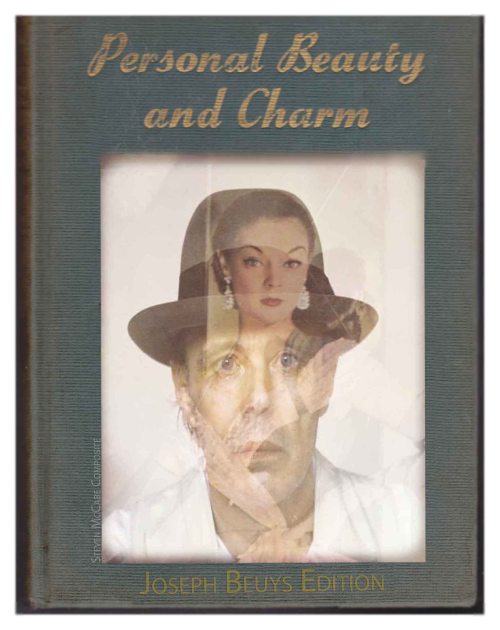
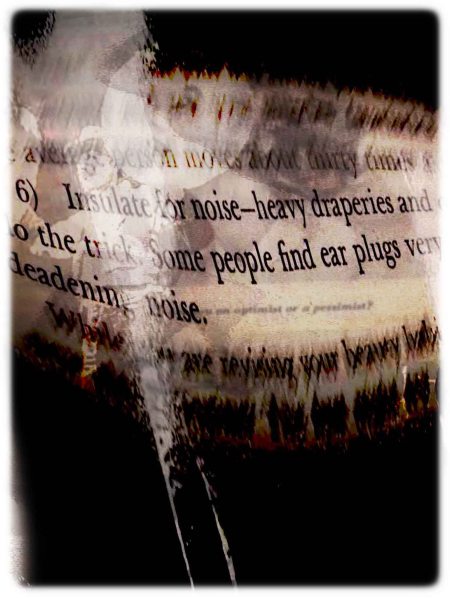
I wrote a line about beauty being the beginning of silence
a pyramid of soundlessness above a white bed

An intuitive synchronicity guided me
as I arranged unrelated
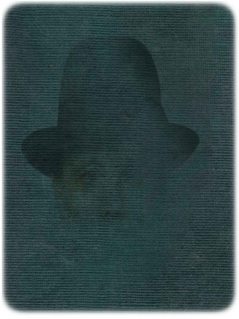
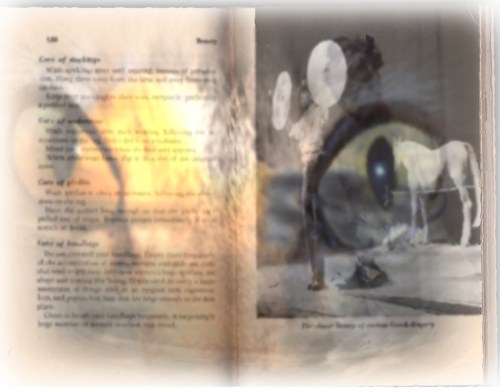
photographs of Joseph Beuys with a book from the 50s

The idea of Greek drapery
flowed into
an action/performance:
Titus Andronicus/Iphigenie

It was Earth Day
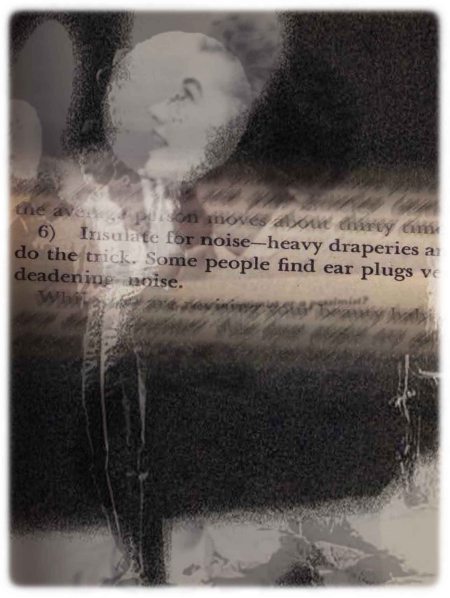
I imagined clicking ‘like’ on a picture of a cat

and the cat saying
Oh
spare me
Seriously
spare me…
And
Joseph Beuys
calming the
creature
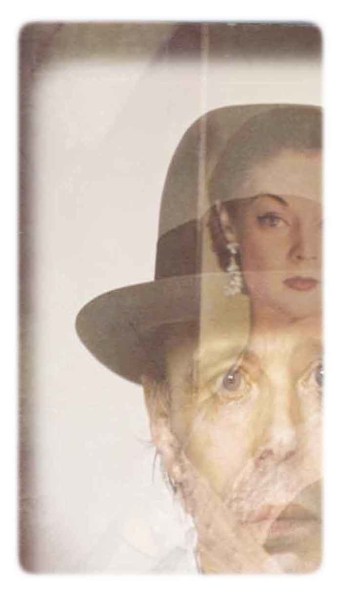
With an
explanation
of sound

How
the simple act
of
perceiving vibrations

Creates
a white bed

&
revolution anew

Casting
obsolete paradigms
aside.

One of Joseph Beuys’ most powerful performances was Titus Andronicus/Iphigenie, performed May-June, 1969 in the Theater am Turm in Frankfurt, Germany for Experimenta 3: http://ropac.net/exhibition/iphigenie
Iphigenia is a daughter of Agamemnon and Clytemnestra in Greek mythology.
Photographs of Joseph Beuys performance: Joseph Beuys foundation. Personal Beauty and Charm published by The Homemaker’s Encyclopedia Inc. 1952. I do not own the copyright any of these photographs. I have refashioned them under fair use provisions to create a new work for non-commercial purposes of parody or commentary.

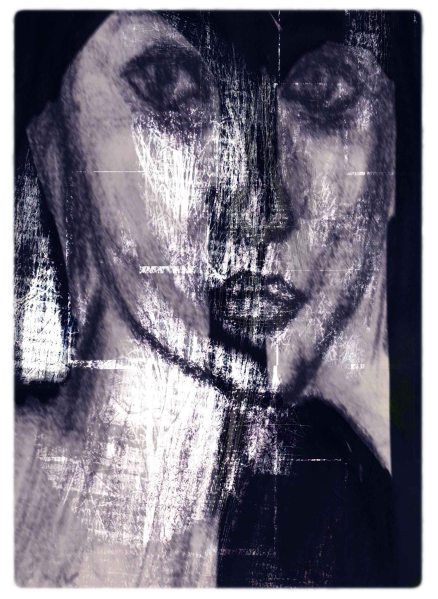
Thinning my studio
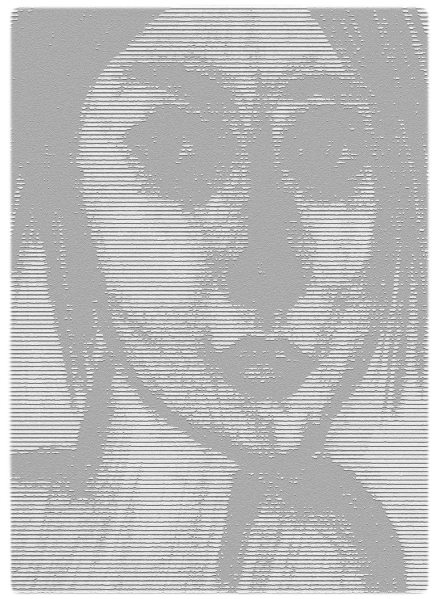
I discover your unlined face looking into the future,

sketched with charcoal on lightweight paper.
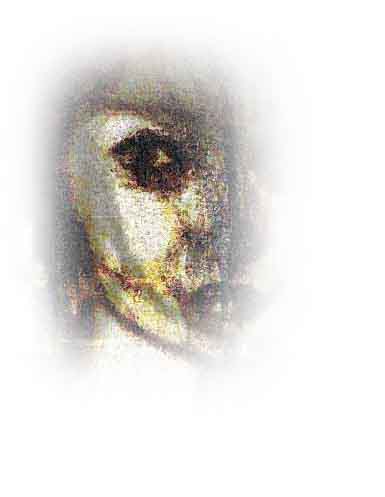
My memory of you
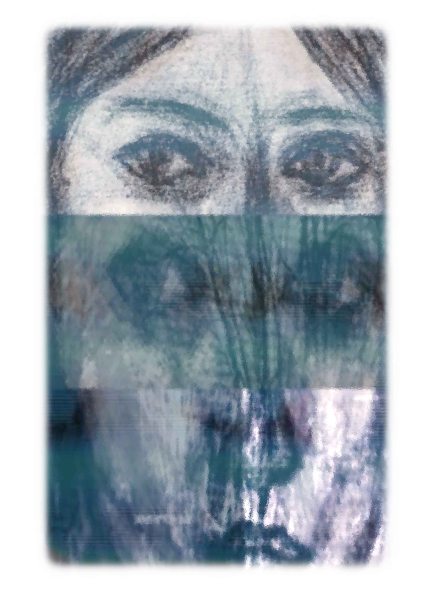
a weak pulse
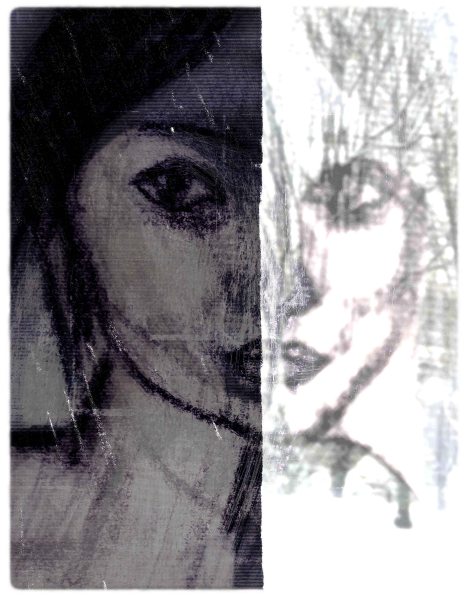
sealed away like a forgotten dimension.
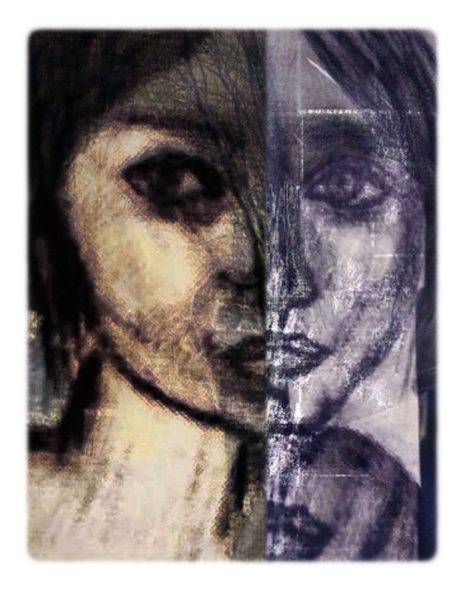
I drop clear, blue, plastic bags to the sidewalk

like fallen
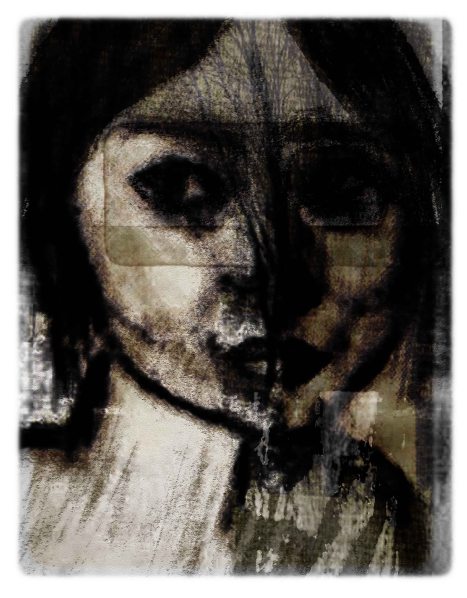
sections of sky,

reported by pilots
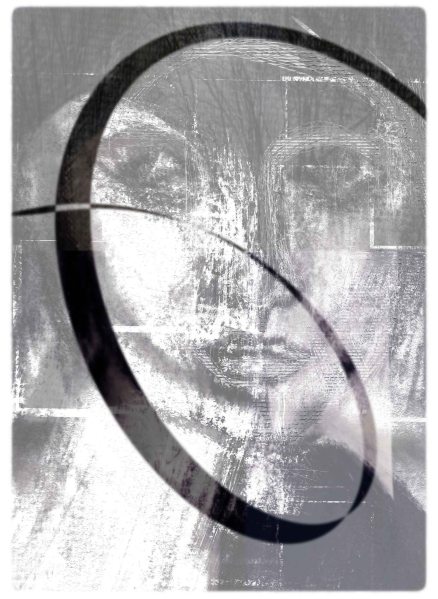
nobody believes.

“Wherever they might be they always remember that the past was a lie, that memory has no return, that every spring gone by could never be recovered, and that the wildest and most tenacious love was an ephemeral truth in the end.”
― Gabriel Garcia Marquez, One Hundred Years of Solitude
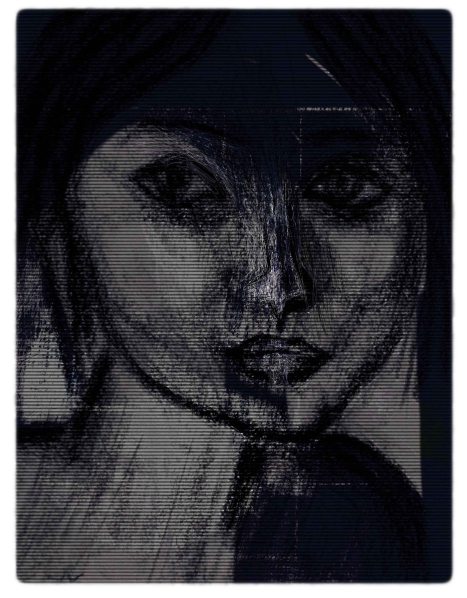
A (forgotten) charcoal drawing digitally contemplated.


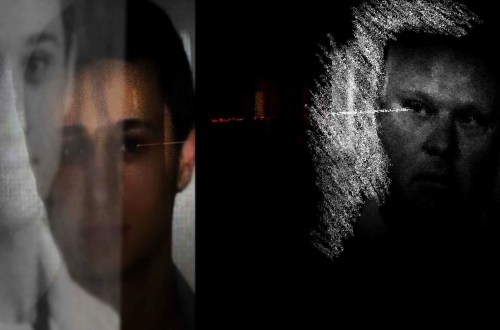
The poem you see
is not the poem
I see,
intones
a merchant
(of some privilege)
in Upper Canada.

His ruffled sleeves
stained
with grease and
gravy.


Your poem
has been singed
by musket powder,
or perhaps
a mishandled lantern,
he mutters,
eating and drinking.
Pausing to smoke from a packed horn pipe.


And more eating
and drinking and
striking the flint
again.

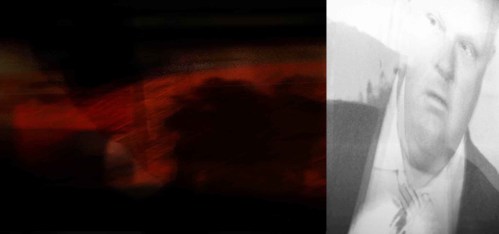
My poem,
on the other
hand,
(jabbing with the fork)
buckles and heaves,
labouring
beneath the fruits of commerce.
Utilitarian in its task.
How opposite to your
verse:

Stanzas fallen,
motionless
on the floor of an electric carriage.

A volley of
projectiles silencing
the pocket-knife
you gestured with.
A strange brew
of calamity
brought upon
yourself.
My eyes are closed
upon your plight,
I do not love thee
or thy sacrifice.

*
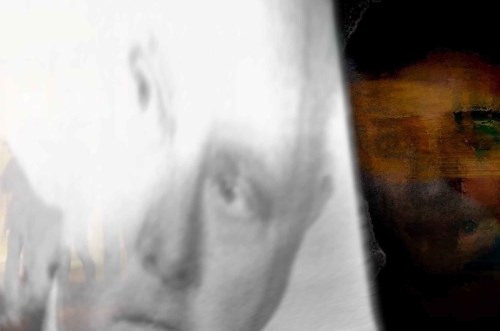
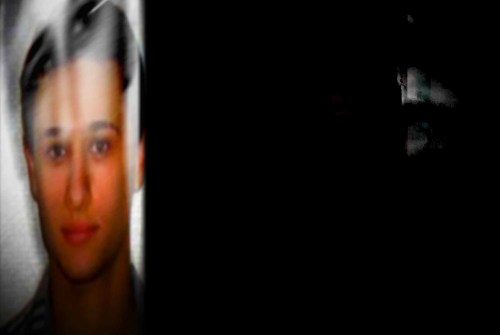
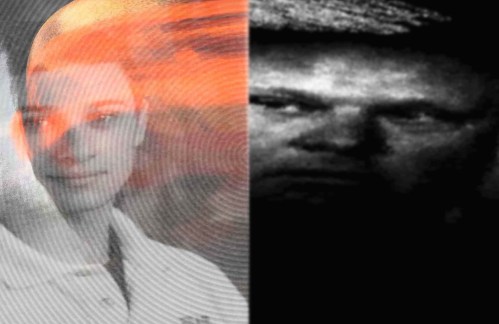
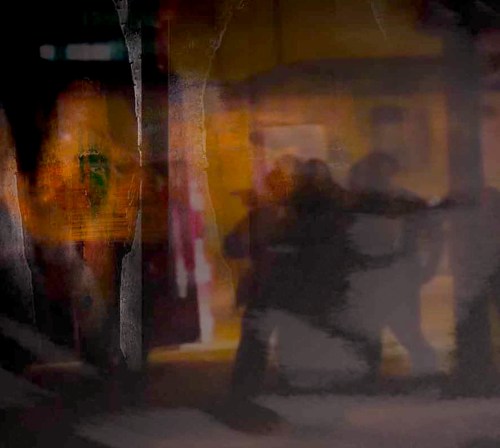
One late summer night last July, 18 year old Sammy Yakim commandeered and emptied a streetcar in Toronto while waving around a small knife and holding his genitals. He was surrounded by a bevy of police officers and shot dead. One of the nine bullets might have missed. Then they tasered him.
*
I created a Sammy Yakim – Mayor Rob Ford (as merchant of Upper Canada) visual dialogue depicting ‘the chain of office’ as representative of corporate social values having little or no compassion.
*
Upper Canada (b.1791, the predecessor of modern Ontario) was considered by Reformers (see Upper Canada Rebellion) as a rigged game with ‘haves’ and ‘have nots.’ To contextualize this social dynamic: Sammy Yakim would not have been accorded the privilege afforded those with position or connections to the establishment of that time.
*
Could his life have been valued any less, anywhere, any time?
*
The idea for titling this post Like burning coals nine bullets glide came from poetic verse in ‘The U.E.; A Tale of Upper Canada’ by William Kirby:
Like burning coals two rifle bullets glide!
Page 170
*

The Colton Map of Upper Canada (1855)
*
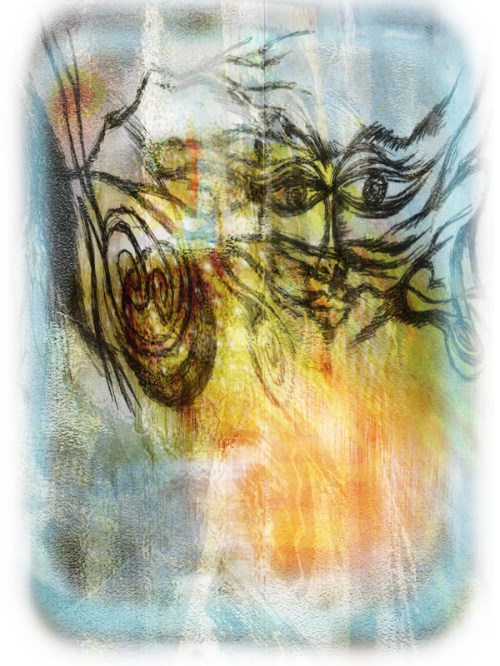
I am surrounded by Crown Island,
a weave of rock and sand; the waves
lap against me, sizzling white strings.
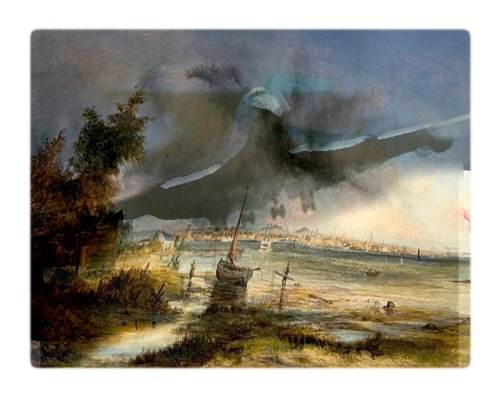
Come said the Muse,
Sing me a song no poet yet has chanted,
Sing me the universal.
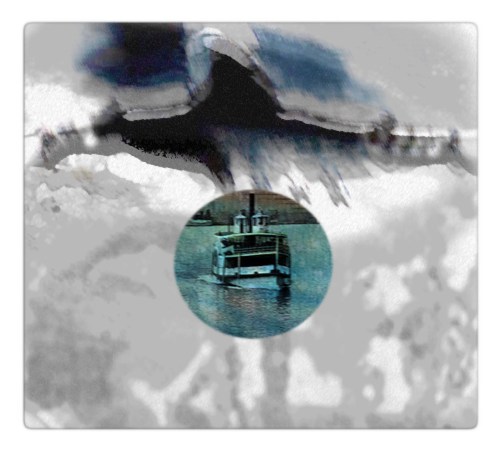
In this broad earth of ours,
Amid the measureless grossness and the slag,
Enclosed and safe within its central heart,
Nestles the seed perfection.

By every life a share or more or less,
None born but it is born, conceal’d or unconceal’d the seed is waiting.
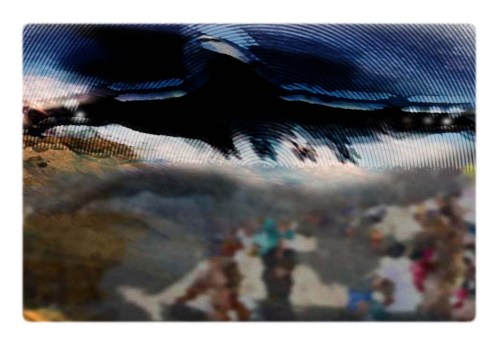
Lo! keen-eyed towering science,
As from tall peaks the modern overlooking,
Successive absolute fiats issuing.

Yet again, lo! the soul, above all science,
For it has history gather’d like husks around the globe,
For it the entire star-myriads roll through the sky.

In spiral routes by long detours,
(As a much-tacking ship upon the sea,)
For it the partial to the permanent flowing,
For it the real to the ideal tends.

For it the mystic evolution,
Not the right only justified, what we call evil also justified.

Forth from their masks, no matter what,
From the huge festering trunk, from craft and guile and tears,
Health to emerge and joy, joy universal.

Out of the bulk, the morbid and the shallow,
Out of the bad majority, the varied countless frauds of men and states,
Electric, antiseptic yet, cleaving, suffusing all,
Only the good is universal.

Over the mountain-growths disease and sorrow,
An uncaught bird is ever hovering, hovering,
High in the purer, happier air.

From imperfection’s murkiest cloud,
Darts always forth one ray of perfect light,
One flash of heaven’s glory.

To fashion’s, custom’s discord,
To the mad Babel-din, the deafening orgies,
Soothing each lull a strain is heard, just heard,
From some far shore the final chorus sounding.
O the blest eyes, the happy hearts,
That see, that know the guiding thread so fine,
Along the mighty labyrinth.

Song of the Universal
Walt Whitman, from Book XVII: Birds of Passage, Leaves of Grass, Project Gutenberg
Imagining Walt Whitman (1819 – 1892) addressing this issue,
I considered his thoughts pertaining to all matters,
expressed in his poetry.
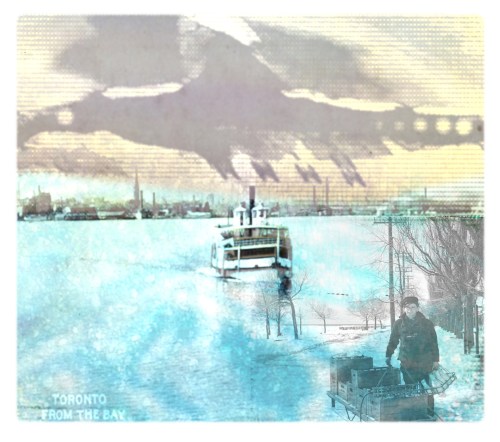
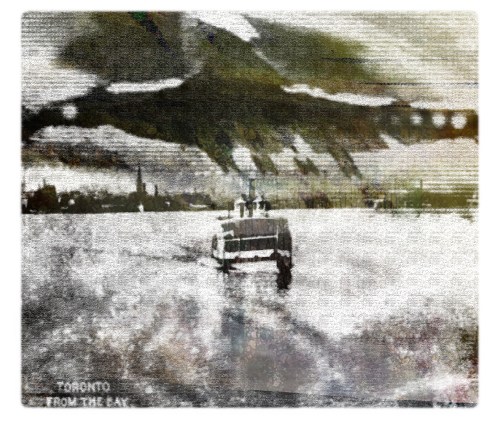
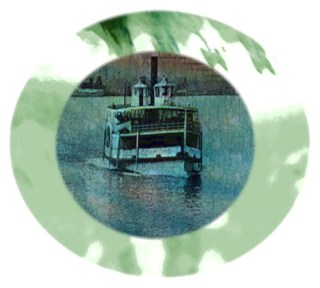
Archival, public domain photographs of Toronto Island found on Wikimedia Commons.
Images include:
Painting by Arthur Cox (1840 – 1917) Toronto from the Island, 1875 (Public Domain), Toronto Public Library
*
A 1907 postcard of a Toronto Ferry Company ferry crossing the bay from the city of Toronto to the Toronto Islands, (Public Domain) Halton Hill Public Library
*
Hanlan’s Point Hotel and Regatta, 1907, (Public Domain) photo: William James, City of Toronto Archives
*
Milkman, Toronto Islands, 1944, Public Domain
*
Photo of Main Street (below), Centre Island, Toronto, 1944, Souvenir Folder of Toronto Islands, Photogelatine Engraving, Ottawa, Ontario (Public Domain)

The majority of Toronto residents living on Toronto Island were evacuated in the 1950s to make room for parkland.
*
The source for the pterodactyl jet was a generic, uncredited image.
*
The planet is a little outraged girl
With its days without dolls and its eyes without pupils
Her bundle awaits on a strange train platform
Next to millions of sadnesses without reply
A train that will carry to the tomb her gloveless heart
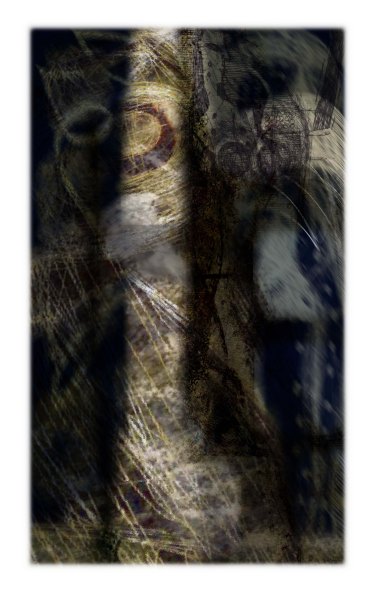
A plucked nib on my chest, this is the world
Stone hole, empty gap
All the chalices converge on my blood
I am a fountain positioned to offer
But the wound passes through the mouth of the poem
Abandonment resists the sky
And rattles the soul of the earth.
Or perhaps, is God dead?
All abandoned
Abandoned
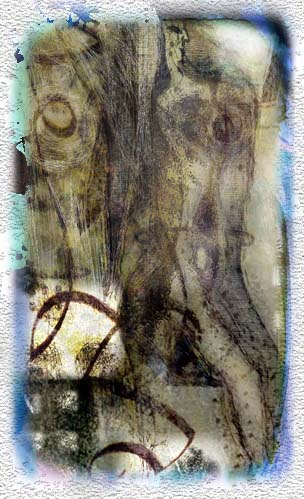
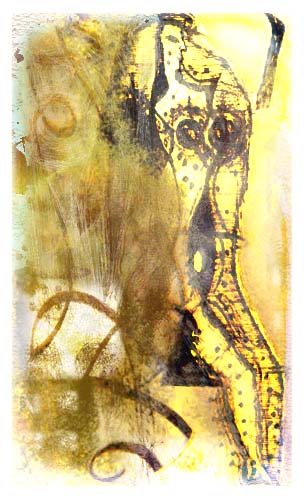
Why do they, my eyes, look at them inside?
And why do they inside these beings look at my eyes?
No one but the Absolute answers.
Crystal and steel I am, but everyone sees the sword
And no one could imagine my crystals in shards
I will resist in an armour of poetry
I will resist swinging from the murmur of the stars
I will resist perched on the peek of a blade of grass
Attached to this moon of snow sailing through the mists
Who stare at me from the branch of the tree, that they cradle.
I can still open my hands to Those about me
I will not die without seeing that in the bundle Christ sings
I will not die before the compass foretells an epiphany.
Cristina Castello is an Argentinian poet and journalist now living in France. Her work is committed to peace and beauty against all social injustices. Her poems are always a commitment to the dignity of life, beauty and freedom. They have been translated into several languages. Her books include, Soif, (L’Harmattan 2004); Orage, (Bod 2009),Ombre (Trames 2010) and “Le chant des sirènes” / “El canto de las sirenas” (Chemins de plume, 2012).
Pierre L’Abbe is a Toronto translator, publisher, ebook designer and author of both poetry and short story collections.


 poemimage